Continuity principles:
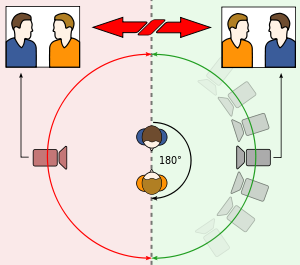
180 degree rule:
The 180 degree rule states that two characters in the same scene should always have the same left/right relationship. However, if the camera moves to the other side of the imaginary line linking the two characters audiences can become disorientated and confused. This was a guideline we had to follow when shooting our preliminary task and we thought very carefully about not crossing it.
In order to avoid crossing the invisible line we enforced the 180 degree rule by having the characters conversation close to a wall. This helped us not forgot to put it in place as there wasn't really much room to try and film from the other side of the characters, therefore being able to keep the visual well being of the viewers intact.
Match on action:
Match on action is the process of cutting from one shot to another view in order to maintain the motion whilst engaging with the previous shot. The use of this principle makes shot changes more fluid. This was also a principle that we had to enforce in our preliminary task.
Our group managed to execute the use of match on action. For example, in the stills on the right Chione can be seen walking round the corner from one angle and then another. All whilst she is walking in the same manner.
This indicates that we have managed to keep the same pace of action going in a different perspective whilst still ensuring that the shot change is fluid.
Shot reverse shot:
This technique is used in order to show two people looking at each other/talking. Basically, the shot reveals one character looking at another and then it changes to the other character looking at the first character. We had to use this technique in our preliminary task in order to portray a fluent conversation.
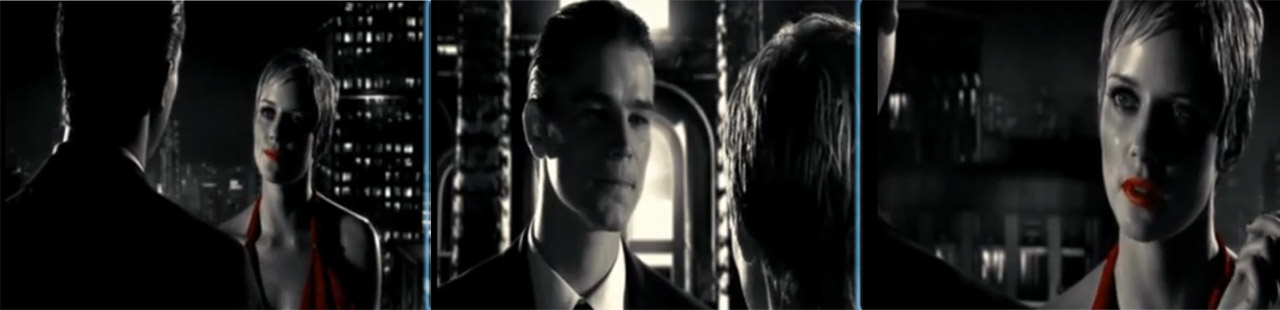
As a group we were successful at incorporating the shot reverse shot technique. For example, the first still on the right indicate that Elizabeth is looking at Chione, then we can tell that she definitely is by the second still. The same applies for Chione.
This suggests that we have effectively demonstrated the technique as we have stuck to the main principles and incorporated them into a short conversation.
Specific camera angles:
I believe the use of this Rule of Thirds shot to be effective and quite interesting within our preliminary task. This is because it divides up the shot into points of interest and balances them out in a visually appealing way. For example, Chione is the main point of interest as her position in relation to the shot captures the most attention.
Secondly, I consider the use of our Long Shot to be successful. This is as the shot demonstrates leading lines and gives the location a more narrow feel, this in turn draws more attention to Chione as she is in the center of where the lines follow. The shot also portrays there to be a vanishing point.
Theme of conversation:
We chose our conversation to be about someone falling asleep whilst doing their media work and therefore forgetting/not being able to meet their friend. Therefore, making her friend quite annoyed. The reason we chose this theme was because we wanted to create a realistic dramatic conversation as apposed to delving into something which may be unbelievable or just silly. We also tried to relate the conversation to the topic i.e. Elizabeth falling asleep whilst specifically doing media work.
Showing posts with label G321 Preliminary task. Show all posts
Sunday, 18 November 2012
Monday, 5 November 2012
Monday, 22 October 2012
Preliminary Task - Evaluation
What planning did you do? How was this useful, and how did you change from your plans?
After looking at the different camera angles in lesson and viewing how they were effective in different locations and scenarios, we were each individually given the task of practicing these various shot types in order get us thinking visually and to experiment with what would/wouldn't work well, in doing this each group member had ideas of what shots and locations to use in the preliminary task. As well as this experience, once we had been formed as a group we discussed suitable plot lines, locations and shots that may cater well for the task. After we had some rough ideas and considerations to which roles we would like to take on within the group we went off and each drafted a storyboard. Once all of us had reviewed each others storyboards we began to brainstorm our thoughts again and shape our final preliminary plan around notions portrayed within our own individual planning (storyboard). We then went out and practiced some of the shots and rules with the camera whilst also making a note of which discussed locations worked well and how relevant the scenario was.
The planning that we carried out was very useful as it allowed each individual member of the group to feed their thoughts and visions into the task and therefore collaborate together to produce a short film that contained aspects we were all happy with. This therefore helped us become more organized as we had a reasonably clear idea to work around, the idea of this organisation also applies to the practice we had with the cameras when we were playing around with our rough final plan. This is as it helps us reach a final conclusion to which locations, scenarios and shot we should use.
When we were in the practice stages and even in some of the final shooting we made a few changes to our plans due to a few ideas not panning out to how we'd imagined. For example, we'd originally discussed perhaps filming our conversation in the school's canteen. However, once we began to practice shooting here we discovered that the atmosphere was quite busy meaning that there were students accidentally getting in the way of shots or distracting us from carrying on. Another negative of this location was that due to the activeness of the surrounding the main dialogue became very hard to hear when played back. Therefore, we decided to re evaluate this idea and practice with another considered location, the location being an unused classroom. This change of environment greatly benefited the task as it was quiet and therefore clear to make out dialogue, also there were no distractions present.
Secondly, we had originally decided on making the conversation about a dramatic event which had effected the character outside of school i.e. Being bitten by a fox. However, after further discussions we came to the conclusion that this was a rather unrealistic scenario and therefore changed it to a topic more believable i.e. The seated character forgetting to meet her friend.
What camera skills have you developed? How confident are you with using the cameras, and has this confidence changed during this project?
Once we were given the cameras I had a chance to familiarize my self with the settings and functions assigned to that specific model of camera by messing about with the features available and figuring out what does what. This helped me gain some confidence as I have not had much experience with the types of camcorders that were available to us and therefore experimenting helped me learn a great deal about how to access different functions. However, using a camera in this set task has allowed my visual side to develop further. This is because practicing with the camera whilst taking into account different shots and rules has given me more of an idea about what would/wouldn't work and can therefore grant me the ability to think in a deeper depth about what it is that I actually want to capture. Although I have developed more confidence with the cameras used in the lesson in the next task I may decide to use my DSLR camera. This is because I have had past experiences with these ranges of cameras and have had a chance to play about and get to know all the features, also, I prefer the overall abilities it is capable of performing.
One area that I believe I need to develop my skills in is taking into consideration ideas about continuity of action whilst filming. This is as when we begun editing it was recognizable that some of the clips didn't quite fit together and consequently composed movements became rather jumpy; imposing the use of video transitions. Nevertheless, I believe this mistake will be beneficial to my overall development as it will prevent me making similar errors on future tasks and as a result favour my progress.
I consider the most effective shots and movements in our preliminary task to convey match-on action. For example, an over-the-shoulder shot where Chione is walking towards the door, the camera then changes to a low angle shot of her reaching out for the door handle and then to a mid shot behind her when she is walking in the door. I believe this to be fitting as it portrays the notion of match-on-action well, where by movements are fluid and place together well with the different camera changes.
What editing skills have you developed? How confident are you with using the editing program?
I have only ever had previous experience on video editing software such as Windows Movie Maker which provides very basic functions and is quite easy to use, therefore when first introduced to Adobe Premiere found it rather confusing and complicated. However, knowing the basics aided me in small ways as it was a bit easier to grasp the concept of the program due to some elements being similar. After a few helpful demonstrations by the teachers and a little play around some of the features became a lot easier to embrace.
After becoming more comfortable with the program I feel that I have developed the ability to add effects such as video transitions between clips and to adjust the length of them accordingly. These effects were important within our task as they allowed us to cut from one clip to the next without having to match the direct movements with the character and therefore cleared up any jumpy scenes that were present. Another skill that I have developed through editing is the ability to cut unnecessary parts out of clips and therefore trim the scene to what is desired. This is helpful as it allows continuity to flow freely where as if the original clips were just bunged together there would be unwanted audio or waiting to role camera/ finish filming.
The areas I need to develop on within editing are mainly to discover what other functions the software offers and learn how I can use them in order to benefit the films I produce. Also, I feel I need to further develop my ability to manipulate audio so that there are no irrelevant sounds in the productions as I still find this quite confusing to achieve.
Other comments:
Our group worked well together and everyone was really engaged in the task, it was great to be able to throw all of our ideas together and collaborate to produce a film that suited all of our visual thoughts. We worked considerately and carefully to ensure that we did not break the 180 degree rule, purely because of the importance of it being enforced. For example, if the rule is broken it can disorientate and confuse the audience.
After looking at the different camera angles in lesson and viewing how they were effective in different locations and scenarios, we were each individually given the task of practicing these various shot types in order get us thinking visually and to experiment with what would/wouldn't work well, in doing this each group member had ideas of what shots and locations to use in the preliminary task. As well as this experience, once we had been formed as a group we discussed suitable plot lines, locations and shots that may cater well for the task. After we had some rough ideas and considerations to which roles we would like to take on within the group we went off and each drafted a storyboard. Once all of us had reviewed each others storyboards we began to brainstorm our thoughts again and shape our final preliminary plan around notions portrayed within our own individual planning (storyboard). We then went out and practiced some of the shots and rules with the camera whilst also making a note of which discussed locations worked well and how relevant the scenario was.
The planning that we carried out was very useful as it allowed each individual member of the group to feed their thoughts and visions into the task and therefore collaborate together to produce a short film that contained aspects we were all happy with. This therefore helped us become more organized as we had a reasonably clear idea to work around, the idea of this organisation also applies to the practice we had with the cameras when we were playing around with our rough final plan. This is as it helps us reach a final conclusion to which locations, scenarios and shot we should use.
When we were in the practice stages and even in some of the final shooting we made a few changes to our plans due to a few ideas not panning out to how we'd imagined. For example, we'd originally discussed perhaps filming our conversation in the school's canteen. However, once we began to practice shooting here we discovered that the atmosphere was quite busy meaning that there were students accidentally getting in the way of shots or distracting us from carrying on. Another negative of this location was that due to the activeness of the surrounding the main dialogue became very hard to hear when played back. Therefore, we decided to re evaluate this idea and practice with another considered location, the location being an unused classroom. This change of environment greatly benefited the task as it was quiet and therefore clear to make out dialogue, also there were no distractions present.
Secondly, we had originally decided on making the conversation about a dramatic event which had effected the character outside of school i.e. Being bitten by a fox. However, after further discussions we came to the conclusion that this was a rather unrealistic scenario and therefore changed it to a topic more believable i.e. The seated character forgetting to meet her friend.
What camera skills have you developed? How confident are you with using the cameras, and has this confidence changed during this project?
Once we were given the cameras I had a chance to familiarize my self with the settings and functions assigned to that specific model of camera by messing about with the features available and figuring out what does what. This helped me gain some confidence as I have not had much experience with the types of camcorders that were available to us and therefore experimenting helped me learn a great deal about how to access different functions. However, using a camera in this set task has allowed my visual side to develop further. This is because practicing with the camera whilst taking into account different shots and rules has given me more of an idea about what would/wouldn't work and can therefore grant me the ability to think in a deeper depth about what it is that I actually want to capture. Although I have developed more confidence with the cameras used in the lesson in the next task I may decide to use my DSLR camera. This is because I have had past experiences with these ranges of cameras and have had a chance to play about and get to know all the features, also, I prefer the overall abilities it is capable of performing.
One area that I believe I need to develop my skills in is taking into consideration ideas about continuity of action whilst filming. This is as when we begun editing it was recognizable that some of the clips didn't quite fit together and consequently composed movements became rather jumpy; imposing the use of video transitions. Nevertheless, I believe this mistake will be beneficial to my overall development as it will prevent me making similar errors on future tasks and as a result favour my progress.
I consider the most effective shots and movements in our preliminary task to convey match-on action. For example, an over-the-shoulder shot where Chione is walking towards the door, the camera then changes to a low angle shot of her reaching out for the door handle and then to a mid shot behind her when she is walking in the door. I believe this to be fitting as it portrays the notion of match-on-action well, where by movements are fluid and place together well with the different camera changes.
What editing skills have you developed? How confident are you with using the editing program?
I have only ever had previous experience on video editing software such as Windows Movie Maker which provides very basic functions and is quite easy to use, therefore when first introduced to Adobe Premiere found it rather confusing and complicated. However, knowing the basics aided me in small ways as it was a bit easier to grasp the concept of the program due to some elements being similar. After a few helpful demonstrations by the teachers and a little play around some of the features became a lot easier to embrace.
After becoming more comfortable with the program I feel that I have developed the ability to add effects such as video transitions between clips and to adjust the length of them accordingly. These effects were important within our task as they allowed us to cut from one clip to the next without having to match the direct movements with the character and therefore cleared up any jumpy scenes that were present. Another skill that I have developed through editing is the ability to cut unnecessary parts out of clips and therefore trim the scene to what is desired. This is helpful as it allows continuity to flow freely where as if the original clips were just bunged together there would be unwanted audio or waiting to role camera/ finish filming.
The areas I need to develop on within editing are mainly to discover what other functions the software offers and learn how I can use them in order to benefit the films I produce. Also, I feel I need to further develop my ability to manipulate audio so that there are no irrelevant sounds in the productions as I still find this quite confusing to achieve.
Other comments:
Our group worked well together and everyone was really engaged in the task, it was great to be able to throw all of our ideas together and collaborate to produce a film that suited all of our visual thoughts. We worked considerately and carefully to ensure that we did not break the 180 degree rule, purely because of the importance of it being enforced. For example, if the rule is broken it can disorientate and confuse the audience.
Monday, 8 October 2012
Preliminary Plan
Group 4:
Elizabeth, Adam and Chione.
Roles:
Walking actress - Chione
Actress sitting in room - Elizabeth
Camera man - Adam
Shot List:
Long to Mid shot - Chione walks down the flight of stairs whilst the camera is held steady at the bottom.
Match on action - Chione walks round the corner from the bottom of the steps, the position of the camera then changes from behind her to in front of her allowing us to view her come around the corner from the front as so to keep up with her movements.
Long to Mid shot - Chione walks down the corridor from a distance gradually getting closer to the camera.
Big close up (from the side) - Chione walks along the corridor whilst the camera is tracking along with her.
Over the shoulder shot - Chione walks towards the door whilst the camera is following/tracking her.
Low angle shot - Camera is facing Chione from a low angle as she reaches out to open the door.
Match on action - The camera position changes to behind Chione as she opens the door to
present a fluid flow of action matching the previous shot.
Rule of thirds - Chione is standing in the foreground of the shot on the right side, whereas Elizabeth is seated in the background on the left side.
Mid shot - Chione enters the shot and sits down whilst Elizabeth is waking herself up.
Shot reverse shot/ Over the shoulder - Chione and Elizabeth exchange dialogue.
Mid shot/ Over the shoulder - Chione gets up to leave.
High angle shot/ Match on action - The action of leaving is continued from a different angle as Chione walks out of the room.
Locations:
Elizabeth, Adam and Chione.
Roles:
Walking actress - Chione
Actress sitting in room - Elizabeth
Camera man - Adam
Shot List:
Long to Mid shot - Chione walks down the flight of stairs whilst the camera is held steady at the bottom.
Match on action - Chione walks round the corner from the bottom of the steps, the position of the camera then changes from behind her to in front of her allowing us to view her come around the corner from the front as so to keep up with her movements.
Long to Mid shot - Chione walks down the corridor from a distance gradually getting closer to the camera.
Big close up (from the side) - Chione walks along the corridor whilst the camera is tracking along with her.
Over the shoulder shot - Chione walks towards the door whilst the camera is following/tracking her.
Low angle shot - Camera is facing Chione from a low angle as she reaches out to open the door.
Match on action - The camera position changes to behind Chione as she opens the door to
present a fluid flow of action matching the previous shot.
Rule of thirds - Chione is standing in the foreground of the shot on the right side, whereas Elizabeth is seated in the background on the left side.
Mid shot - Chione enters the shot and sits down whilst Elizabeth is waking herself up.
Shot reverse shot/ Over the shoulder - Chione and Elizabeth exchange dialogue.
Mid shot/ Over the shoulder - Chione gets up to leave.
High angle shot/ Match on action - The action of leaving is continued from a different angle as Chione walks out of the room.
Locations:
| Staircase (City of Norwich School) |
| Corridor (City of Norwich School) |
| Canteen (City of Norwich School) |
| Catering Classroom (City of Norwich School) |
Tuesday, 18 September 2012
Types of camera shots
High angle:
In this shot I am attempting to convey the insignificance of the characters. It's almost as if the height is over-powering them and they are worthless from the camera's perspective.
Low angle:
This shot conveys the power in which the character has as it makes him seem taller and more intimidating. Along with the rather cold colours and dirty stair blocks this image presents a rather unfriendly atmosphere and indicates towards the character being a ''hoodlum''.
Over the shoulder:
For example, this still is from the television drama 'Misfits' and uses an over the shoulder shot in a moment of tension whereby the character is unknowingly going to be affected by what lies a head of him.

Over the shoulder (alternative focus):
I decided to take the shot again but focusing more on the action of the scene. This works quite well as it allows the audience a clearer idea of what's happening in the scene.
Tilt:
I find the tilt shot quite effective as
it leaves the audience in a visual daze, as if in a nightmare. The disorientating
nature of this shot gives the character a stature of a notoriously devious icon.
Long shot:
In this image I used a long shot in order to establish the characters surrounding. Long shots are effective in films and television programmes as they display to the audience where the main part of action is going to take place and allow us to see more details of the location.
Medium close-up:
This type of close-up works well for bringing most of the characters upper body into focus.
Close-up:
a Close-up is effective for understanding how the character is feeling. It is a good shot to use in film making because it allows the audience to relate with the characters emotions given their situation and gain a better idea of what is going on.
Extreme close-up:
This type of close-up is used to emphasize facial features to make them appear more emotional or even more emotionless.
For example, in the film "A Clockwork Orange" there is an extreme close-up on Alex's eye (Main character) in which just from the movements of a few facial features we can read his confusion and terror.
Bird's eye view:
This shot gives the audience a different view of the action and could also be effective in communicating vulnerability where in this case the characters are in an enclosed area (alleyway).
Worm's eye view:
The worm's eye view gives the audience a view from the perspective of a powerless character. In this case, the character is at a very low level and surrounded by three others who in light of the angle seem very menacing. I took inspiration from Quentin Tarantino in this shot as he has captured it in similar ways throughout some of his films (Kill Bill, Reservoir Dogs, Inglorious Basterds, etc)
For example, from this perspective the man in the boot is completely overpowered by the three criminals, all of which seem very intimidating.
Rule of thirds:
This type of shot draws the audiences attention on to one section of the image i.e the character watching behind the container.
In this shot I am attempting to convey the insignificance of the characters. It's almost as if the height is over-powering them and they are worthless from the camera's perspective.
Low angle:
This shot conveys the power in which the character has as it makes him seem taller and more intimidating. Along with the rather cold colours and dirty stair blocks this image presents a rather unfriendly atmosphere and indicates towards the character being a ''hoodlum''.
Over the shoulder:
The over the shoulder shot allows the audience to be placed in the characters shoes and view the scene from a more realistic perspective. This is effective as it draws a more shallow focus on the character.
For example, this still is from the television drama 'Misfits' and uses an over the shoulder shot in a moment of tension whereby the character is unknowingly going to be affected by what lies a head of him.
Over the shoulder (alternative focus):
I decided to take the shot again but focusing more on the action of the scene. This works quite well as it allows the audience a clearer idea of what's happening in the scene.
Tilt:
I find the tilt shot quite effective as
it leaves the audience in a visual daze, as if in a nightmare. The disorientating
nature of this shot gives the character a stature of a notoriously devious icon.
In this image I used a long shot in order to establish the characters surrounding. Long shots are effective in films and television programmes as they display to the audience where the main part of action is going to take place and allow us to see more details of the location.
Medium close-up:
This type of close-up works well for bringing most of the characters upper body into focus.
Close-up:
a Close-up is effective for understanding how the character is feeling. It is a good shot to use in film making because it allows the audience to relate with the characters emotions given their situation and gain a better idea of what is going on.
Extreme close-up:
This type of close-up is used to emphasize facial features to make them appear more emotional or even more emotionless.
For example, in the film "A Clockwork Orange" there is an extreme close-up on Alex's eye (Main character) in which just from the movements of a few facial features we can read his confusion and terror.
Bird's eye view:
This shot gives the audience a different view of the action and could also be effective in communicating vulnerability where in this case the characters are in an enclosed area (alleyway).
Worm's eye view:
The worm's eye view gives the audience a view from the perspective of a powerless character. In this case, the character is at a very low level and surrounded by three others who in light of the angle seem very menacing. I took inspiration from Quentin Tarantino in this shot as he has captured it in similar ways throughout some of his films (Kill Bill, Reservoir Dogs, Inglorious Basterds, etc)
For example, from this perspective the man in the boot is completely overpowered by the three criminals, all of which seem very intimidating.
Rule of thirds:
This type of shot draws the audiences attention on to one section of the image i.e the character watching behind the container.
Thursday, 13 September 2012
Subscribe to:
Posts (Atom)